

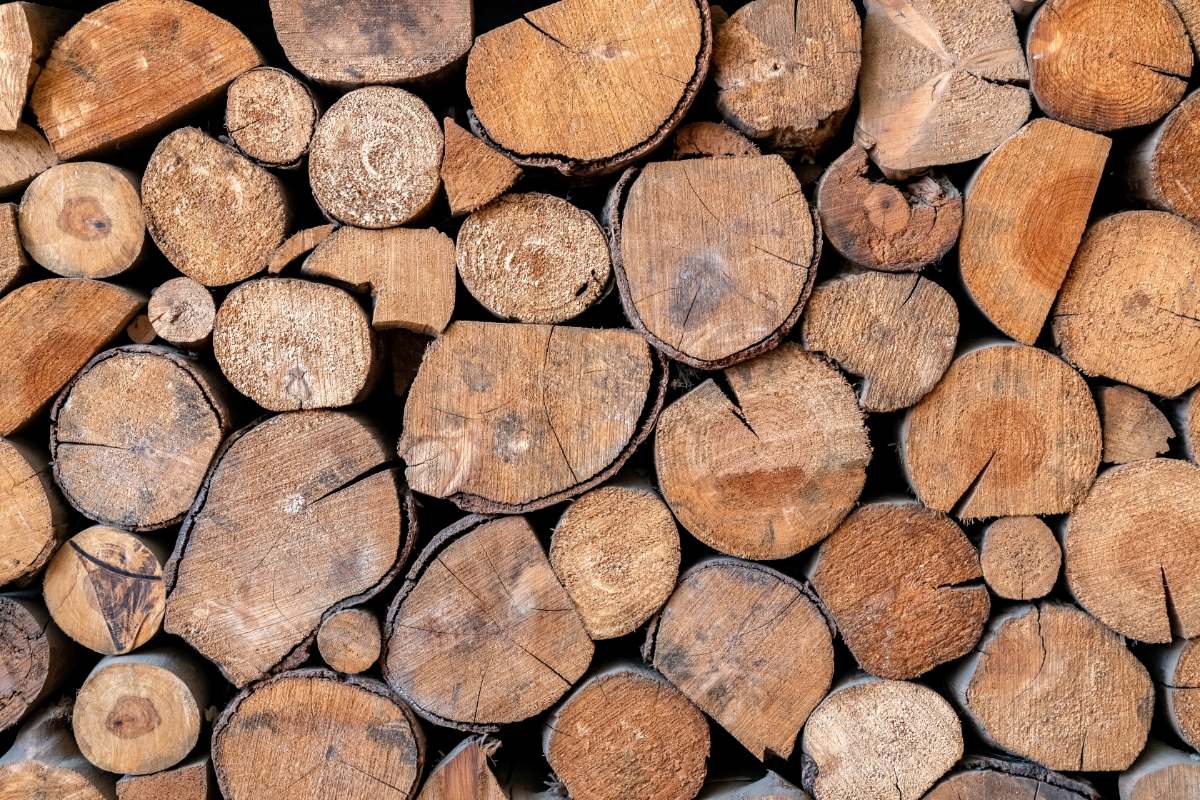
Thermal mass effect is often defined as thermal capacitance or time lag. It is the high heat retention factor of a solid wall to limit heat transfer through itself. A solid log wall in summer will delay the heat trying to get through to the cooler inside of the cabin. In the wintertime, the thick log walls will retain the heat inside. Think of the log walls as a thick barrier to the heat transfer, slowing the movement of heat through the wall.
National Bureau of Standards Study
In 1980 – 1982 the National Bureau of Standards (NBS) did a study for the Department of Housing and Urban Development (HUD) and the Department of Energy (DOE) in an effort to determine the effects of mass on thermal retention.
Identical 20' x 20' buildings were constructed on the NBS grounds, 20 miles north of Washington, D.C., the only difference being the exterior wall construction. During the test the interior temperatures were maintained at the same level and energy usage was measured.
The NBS compared a log building to an insulated conventionally-framed building. The log building was constructed with 7” solid logs rated at a nominal R-10 and the framed building was insulated with 3 ½” of fiberglass and rated at a nominal R-12.
The NBS found that over the winter heating period the two buildings used basically the same energy for heat.
But here's where it gets interesting.
The NBS study also found that:
- During the summer cooling period the log building used 24% less cooling energy
- During the spring heating period the log building actually used 46% less heating energy.
- During the 14-week winter heating period, the log building and the insulated wood fame building used about the same amount of heating energy.
The NBS concluded from this test that the thermal mass of log walls is an energy-conserving feature in residential construction.
R-Values Not Representative
One problem with using R-values alone to compare the thermal performance of materials is that R-values are only a good representation under conditions of constant interior and exterior temperatures. This is just not the case in the real world. The R-value has an inverse correlation to the temperature differential.
Properly constructed log walls can also have less air leakage than conventional stud walls and this drastically reduces heat loss through the walls.
Energy Star has put out a Thermal Bypass Checklist Guide that addresses many of these issues and walks log home builders through what is required to be Energy Star qualified.
Remember there are three types of heat transfer: convection, conduction and radiation and fiberglass insulation basically addresses only convection. A solid log wall also resists the conduction of heat due to the thermal mass of the logs and produces a more eco-friendly home.
More Cabin Efficiency Pages:
Solar Power Saves Money and Resources Both passive solar power and active solar power offer ways to save money along with our planets resources.
Thermal Bypass Checklist Guide The Thermal Bypass Checklist Guide addresses the best practice ways to be qualified as ENERGY STAR.
Log Home Systems – An Integrated Approach Using an integrated approach to log home systems will result in greater efficiency, lower building costs, superior performance and overall savings.
Optimal Value Engineering Optimal Value Engineering is a mindful design process that minimizes waste and increases efficiency.
Energy Efficiency of Log Homes The high energy efficiency of log homes is due to the thermal mass effect.
Leave a Reply